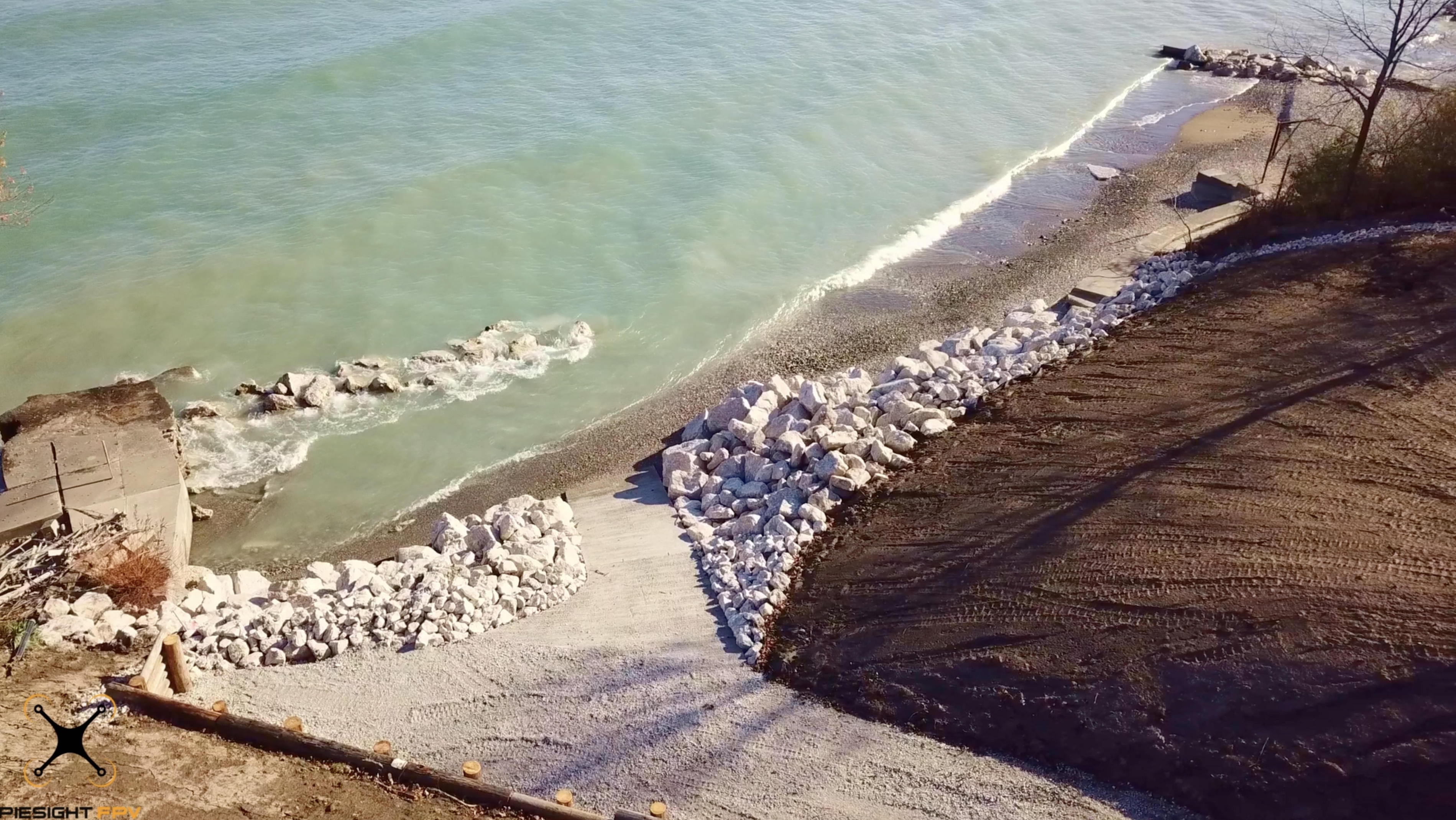
Spring Lakeshore Restoration at a Glance
Winter’s freeze-thaw cycles, ice movement, and snowmelt runoff cause significant shoreline erosion along Lake Michigan — and the damage is often invisible until spring. Warning signs include eroded banks, displaced riprap, exposed tree roots, slumping terrain, and vegetation loss. Professional lakeshore restoration addresses these issues through site assessment, bank regrading, rock revetment installation, erosion control, and native vegetation restoration. Wisconsin shoreline projects require DNR permits, making late winter the ideal time to plan. CK Contractors provides full-service lakeshore restoration for residential and commercial properties throughout southeast Wisconsin.
The Season Is Closer Than You Think
Along the Lake Michigan shoreline, winter doesn’t slow things down — it goes to work on your property. Every freeze-thaw cycle, every ice sheet, every rush of snowmelt quietly tests the stability of your lakeshore. By the time spring arrives, the damage is often already done.
Lakeshore restoration is more than an aesthetic fix. It protects property value, prevents long-term soil loss, ensures safe water access, and keeps your site compliant with Wisconsin environmental standards. According to the U.S. Army Corps of Engineers, Great Lakes shoreline erosion causes an estimated $20 million in property damage annually across the region. When restoration is done right — and done early — it sets the foundation for everything you want to accomplish on your property this year.
At CK Contractors, we specialize in shoreline restoration for residential and commercial properties along Lake Michigan. Our services include shoreline grading, rock revetment and riprap installation, vegetation management, debris removal, and full permitting support. Whether you’re dealing with visible erosion or want a professional assessment before spring, we’re equipped to help.
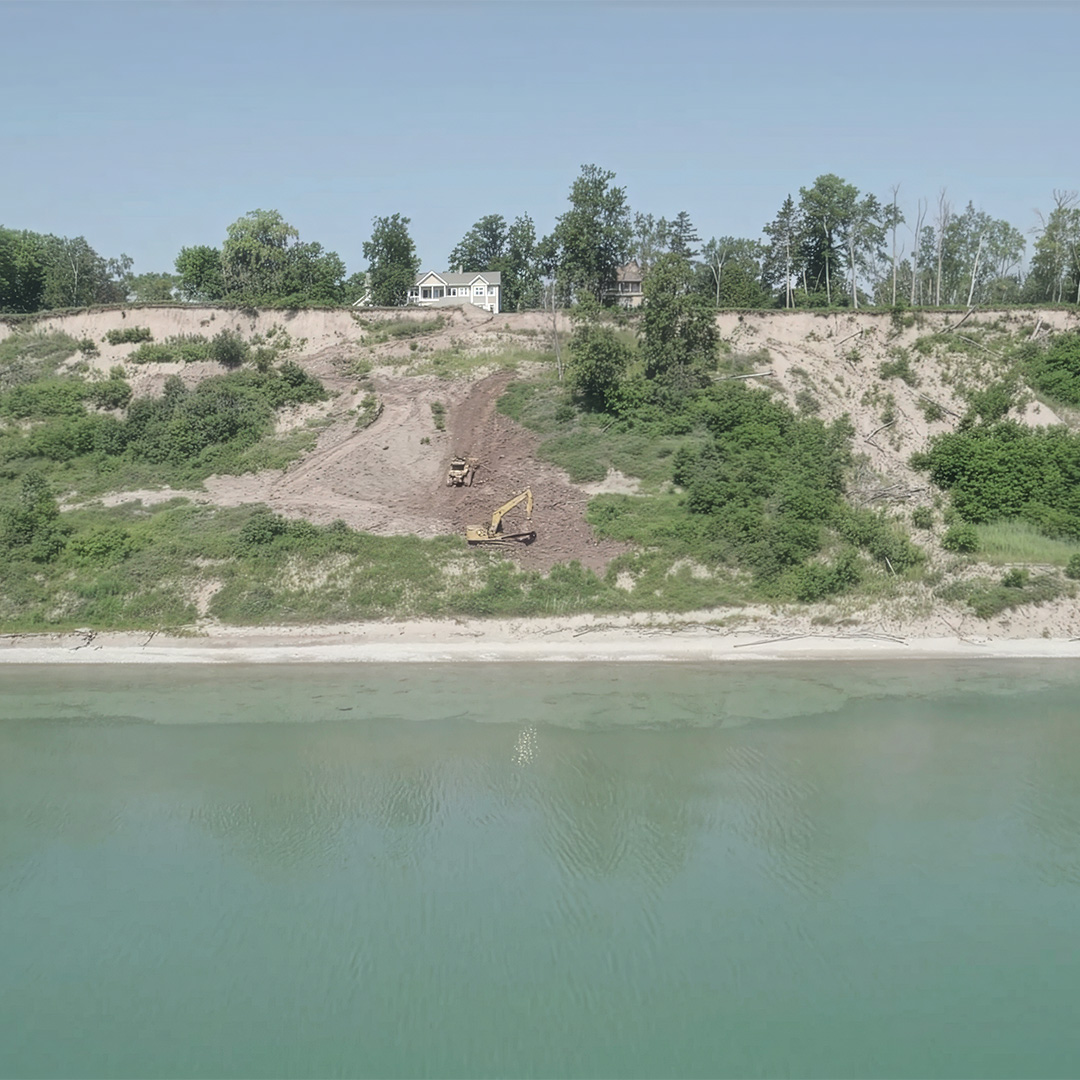
Before
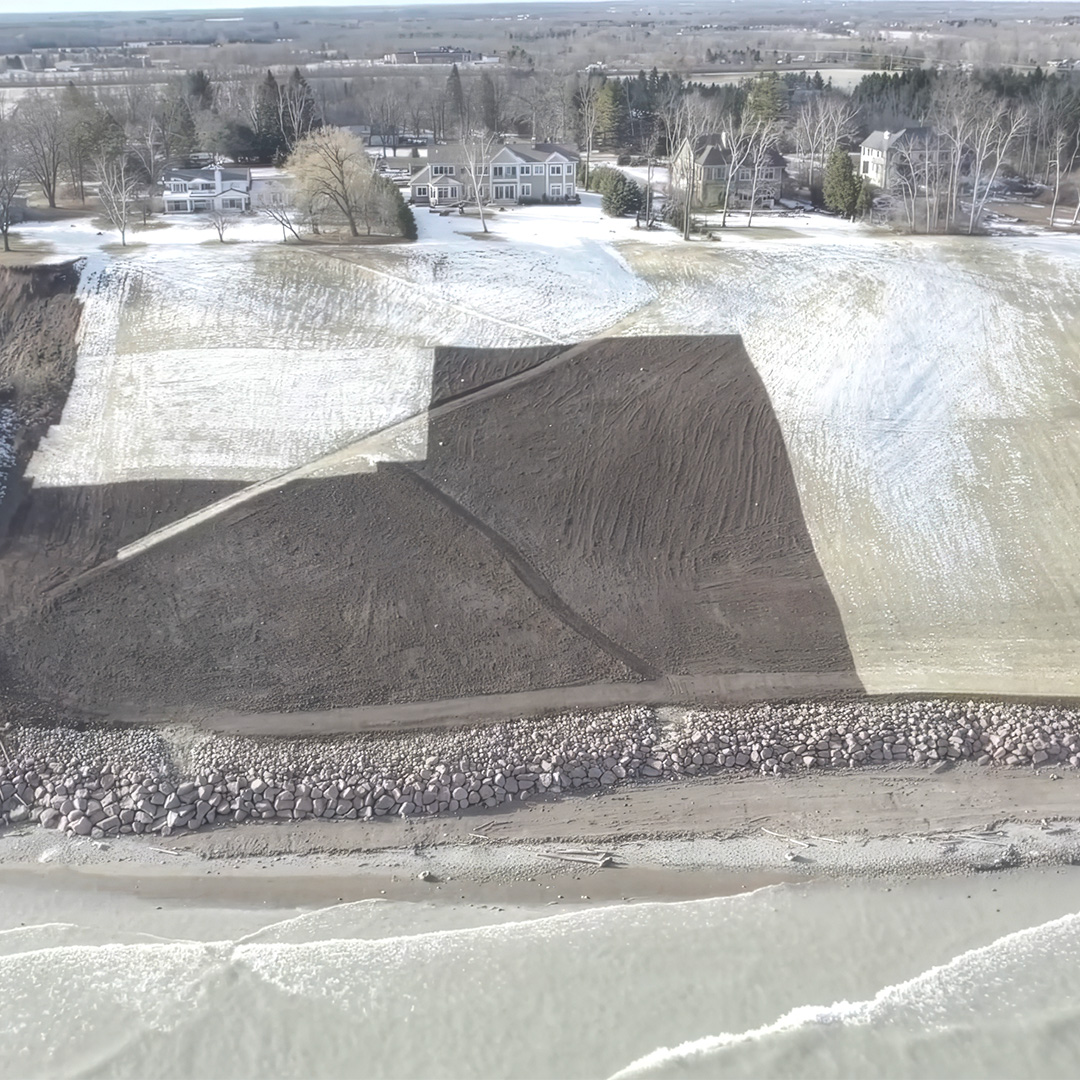
After
What Winter Does to Your Shoreline
Most lakeshore property owners don’t think about their shoreline in January. But winter is when the most significant damage occurs — often without visible signs until March or April.
Freeze-Thaw Erosion
The freeze-thaw cycle is one of the primary causes of shoreline erosion. As temperatures drop, soil moisture near the bank freezes and expands by up to 9% in volume. When temperatures rise, the material thaws and contracts. Repeated over weeks and months, this cycle gradually destabilizes even well-constructed shorelines, loosening rock, shifting fill material, and undermining bank integrity.
Wisconsin’s climate is particularly aggressive. Between November and March, southeast Wisconsin averages over 50 freeze-thaw cycles per season — each one weakening the bank structure incrementally.
Ice Damage
Along Lake Michigan and inland waterways, ice sheets form directly against the shoreline. As they expand, shift, and break up, they physically move riprap, displace soil, and erode the bank face. Ice push forces can exceed 10,000 pounds per linear foot of shoreline, according to Great Lakes coastal engineering studies. What looked solid in October may be significantly compromised by March — even if it’s not obvious at first glance.
Snowmelt and Runoff
Snowmelt and early spring runoff add water volume and velocity to the equation. A single spring thaw can move thousands of gallons of water per acre across unprotected banks, accelerating surface erosion and washing away vegetation that previously held soil in place.
“The compounding effect of freeze-thaw, ice push, and spring runoff means that a shoreline losing even 2 to 3 inches of bank per year can lose several feet of property over a decade. Early assessment is critical.”
— CK Contractors field team
Signs Your Lakeshore Needs Restoration This Spring
You don’t need to be a contractor to recognize that something is wrong with your shoreline. These are the most common warning signs that shoreline repair is needed before conditions worsen.
Eroded or Undercut Banks
If the bank face looks steeper than it used to, or you can see exposed soil where ground cover once existed, erosion is actively removing material from your property. The Natural Resources Conservation Service (NRCS) estimates that unprotected Great Lakes shorelines lose an average of 1 to 3 feet of bank per year during active erosion cycles.
Displaced or Sunken Riprap
Riprap that has shifted, sunk, or separated signals that the base material beneath may be compromised. Adding more rock on top without addressing the underlying issue only delays the problem — and can actually accelerate failure by adding weight to an unstable foundation.
Exposed Tree Roots Near the Waterline
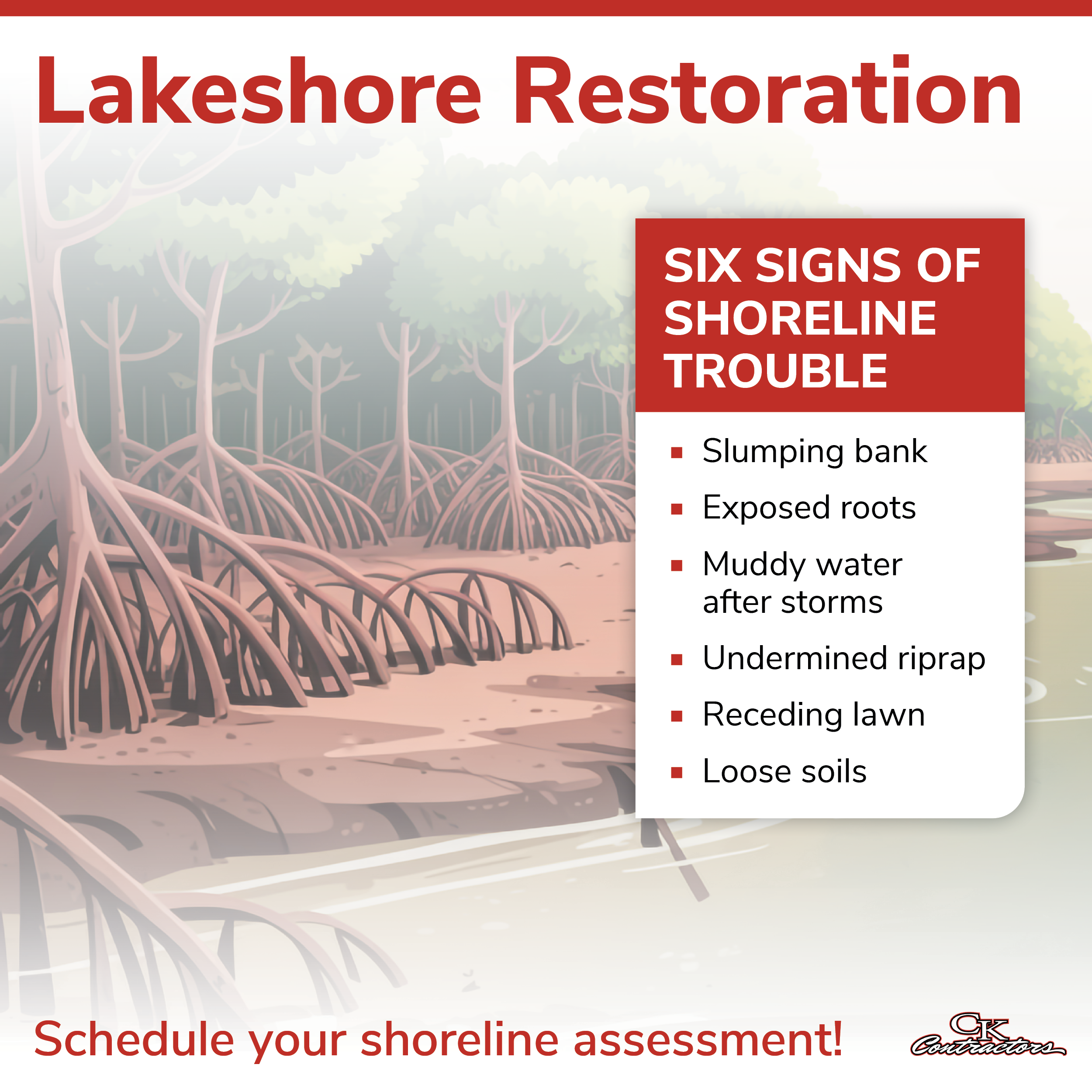
Roots visible above the soil line indicate that surrounding material has eroded away. This puts the trees at risk of destabilization, and falling trees can cause additional bank collapse and debris accumulation.
Slumping or Uneven Terrain Along the Bank
Soft spots, low areas, or visible slumping along the bank edge suggest soil has shifted or settled — often from water infiltration, freeze-thaw movement, or decay of organic material below the surface. Slumping is frequently a precursor to larger bank failures.
Loss of Shoreline Vegetation
Native plants and ground cover do more than look natural — their root systems hold soil in place and slow runoff. Research from the University of Wisconsin–Madison Extension shows that vegetated shorelines experience up to 70% less surface erosion than bare banks. When that vegetation disappears, erosion accelerates rapidly.
Debris Buildup or Sediment Displacement
Accumulation of sediment, debris, or organic material along the bank can disrupt drainage, block natural water flow, accelerate erosion, and create conditions that are difficult to reverse without professional intervention.
What Lakeshore Restoration Actually Involves
Lakeshore restoration is not simply placing rocks along a bank and calling it done. A proper restoration addresses the underlying causes of shoreline erosion and instability — not just the visible symptoms.
Whether you know it as erosion control, armor walls, or rock revetment, our team is skilled in all methods of shoreline stabilization. We tailor our approach to your property’s specific needs. Every site is different, and a solution that works well on one property may not be right for another.
The Restoration Process: Step by Step
- Site assessment and grading evaluation — Understanding existing conditions, drainage patterns, soil composition, and structural challenges before any work begins.
- Bank stabilization and regrading — Reshaping the land to establish a stable slope angle (typically 2:1 or 3:1 horizontal-to-vertical ratio) that resists gravitational and wave erosion.
- Rock revetment or riprap installation — Placing the primary physical barrier against wave action and erosion. Properly sized and placed riprap can protect a shoreline for 25 to 50 years.
- Geotextile fabric installation — Prevents soil migration through gaps in the stone while maintaining natural drainage.
- Erosion control measures — Addressing surface water movement with drainage solutions, berms, and grade breaks.
- Native vegetation restoration — Establishing deep-rooted native plants that create a secondary, natural barrier. Established native plantings reduce surface runoff by up to 70% and improve long-term bank stability.
- Debris and sediment removal — Clearing the site to ensure it is clean, functional, and compliant.
What Is Riprap and How Does It Work?
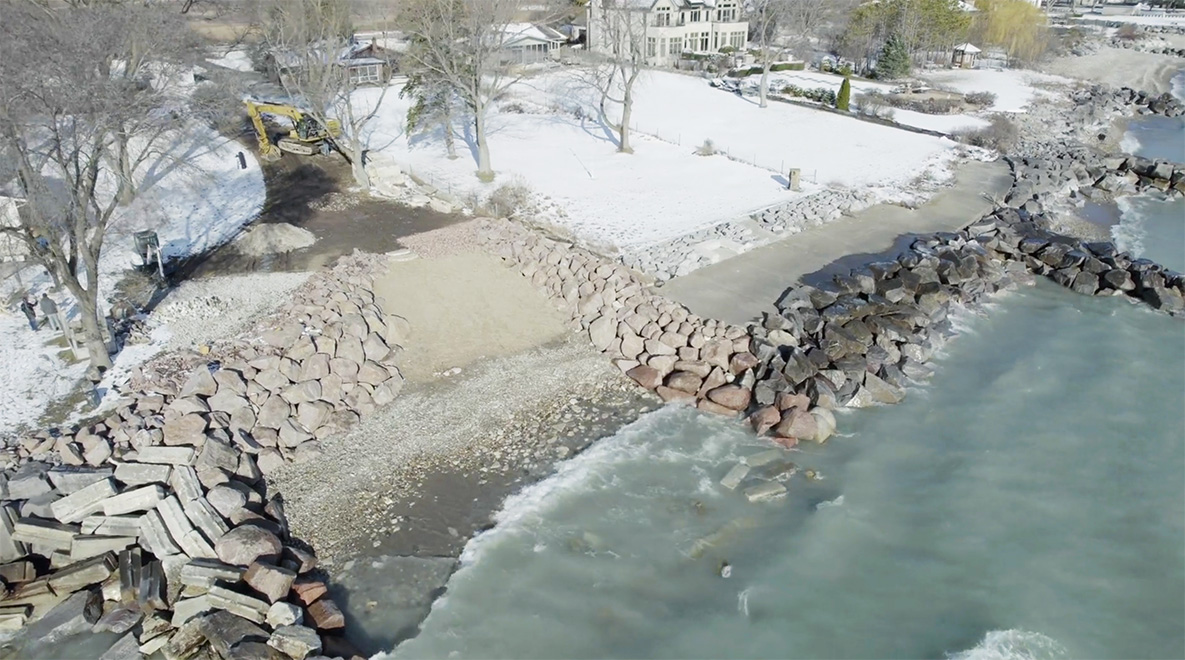
Riprap is loose stone or rock placed along a shoreline to absorb and redirect wave energy. The interlocking stones dissipate the force of water impact before it reaches the soil bank. Riprap is the most widely used shoreline protection method along the Great Lakes, with the U.S. Army Corps of Engineers recommending it as a primary erosion control measure for exposed lakefront properties.
The key to effective riprap installation is proper sizing, placement, and foundation preparation. Stone that is too small will be displaced by wave action. Stone placed without geotextile fabric will allow soil to migrate through gaps, causing settlement and failure. A professional installation accounts for wave height, fetch distance, bank slope, and soil conditions to design a system that lasts.
Permits and Compliance: What Wisconsin Lakeshore Owners Need to Know
Shoreline work along Lake Michigan and Wisconsin waterways is subject to oversight from multiple regulatory bodies. Skipping the permitting process — or being unaware of it — can result in fines, forced restoration, or significant project delays.
| Agency | When Required | Typical Timeline |
|---|---|---|
| Wisconsin DNR | Grading, riprap installation, or work within the 75-foot shoreline setback zone | 30-60 days |
| U.S. Army Corps of Engineers | Work in or near navigable waters, below the ordinary high-water mark | 60–120 days |
| Local municipality | Varies by county and township — grading permits, erosion control plans | 14-30 days |
Permit requirements vary by project scope and location. Some projects may qualify for general permits with shorter review periods, while larger projects may require individual permits with environmental review.
What Happens Without Permits?
Unpermitted shoreline work can lead to:
- Fines from the Wisconsin DNR — enforcement has increased in recent years
- Required removal or re-restoration at the property owner’s expense
- Complications with property sales — title searches can reveal unpermitted work
- Loss of insurance coverage for shoreline-related damage
CK Contractors Handles Permitting
Environmental considerations are part of every project we take on. Our methods meet or exceed current environmental standards, and we manage the permitting process from application through approval. Starting the permitting process in late winter gives you the best possible chance of being ready to work as soon as spring conditions allow.
Why Late Winter Is the Right Time to Plan
Most lakeshore property owners don’t think about restoration until they’re standing on the bank in June wondering why it looks so much worse than last year. By then, contractor schedules are full, permit processing windows have passed, and the season for efficient shoreline work is already half over.
The Planning Advantage: February Through March
| Factor | Late Winter | Summer |
|---|---|---|
| Contractor Availability | Open schedules, priority booking | Booked weeks or months out |
| Permit Processing | Time to complete before ground thaws | Delays push projects to fall |
| Damage Visibility | Winter damage fresh and clearly visible | Vegetation may mask issues |
| Cost | Standard pricing, no rush premiums | Higher demand, potential premiums |
| Project start | Begins as soon as conditions allow | May not start until late season |
The earlier planning begins, the smoother everything else becomes. There’s time to conduct a proper site assessment, develop the right solution for your specific shoreline, navigate the permitting process without rushing, and lock in a schedule before spring demand peaks.
How Much Does Lakeshore Restoration Cost?
Cost is one of the most common questions property owners have. While every project is different, here are general ranges for residential lakeshore restoration along Lake Michigan:
| Component | Typical Cost Range |
|---|---|
| Site Assessment and Engineering | $500 – $2,500 |
| Bank Regrading | $2,000 – $10,000 |
| Riprap / Rock Revetment Installation | $25 – $75 per linear foot |
| Geotextile Fabric | $1 – $3 per square foot |
| Native Vegetation Restoration | $1,000 – $5,000 |
| Permitting Fees | $300 – $1,500 |
| Total Residential Project | $5,000 – $50,000+ |
Cost factors include: length of shoreline, severity of erosion, type of stabilization method, site accessibility, equipment requirements, stone type and size, and permit complexity.
The cost of inaction is often higher. The Federal Emergency Management Agency (FEMA) estimates that every dollar spent on erosion prevention saves an average of $6 in future repair and property loss costs.
Contact CK Contractors for a project-specific estimate based on your shoreline conditions.
Clear the Way for a Stronger Shoreline This Spring
Winter leaves its mark on every lakeshore property along Lake Michigan. The difference between a shoreline that holds up and one that continues to erode comes down to how early problems are identified and addressed.
At CK Contractors, we bring years of experience along the Lake Michigan shoreline and a full suite of lakeshore restoration services — from initial site assessment through permitting, grading, rock revetment, vegetation, and cleanup. Every property is unique, and we approach each project with that in mind.
Why Property Owners Choose CK Contractors
- Full-service restoration — site assessment, engineering, permitting, construction, and vegetation in one contractor
- Lake Michigan specialists — deep experience with the specific erosion forces, soil conditions, and regulatory requirements of Wisconsin’s lakefront
- Permitting expertise — we manage DNR, Army Corps, and local permit applications from start to finish
- Residential and commercial — projects of all sizes along Lake Michigan and Wisconsin waterways
- Equipment and capability — excavation, grading, rock placement, and site restoration with our own fleet
If you’ve noticed any of the warning signs described here — or simply want a professional evaluation before spring arrives — now is the time to reach out.
Contact CK Contractors to schedule your lakeshore assessment and get your shoreline ready before spring schedules fill up.
Service Area: Southeast Wisconsin, Lake Michigan shoreline, Racine, Kenosha, Milwaukee, and Waukesha counties
Frequently Asked Questions
✅ Get Your Free Shoreline Estimate Today
Do not wait for ice and spring storms to cause costly damage. Book your free shoreline assessment today and let our team design a custom shoreline restoration, erosion control, or waterfront protection solution tailored to your property.