Wisconsin Lakeshore Permitting at a Glance
Every spring, lakeshore property owners along Lake Michigan walk their shoreline and assess the impact winter has had. Eroded banks, shifted riprap, and exposed tree roots are a few of the issues they may see. The next steps should be simple: call a contractor and fix it.
For many property owners, that is where CK Contractors comes in. With experience in lakeshore restoration, including shoreline grading, riprap installation, and erosion control, the team helps turn visible damage into long-term solutions built for Lake Michigan conditions.
But then the questions start. Do I need a permit for this? Who do I call? How long does it take? And what happens if I just move forward without one?
Permitting uncertainty is the single biggest reason lakeshore restoration projects get delayed or never happen at all. The process can involve multiple agencies, overlapping jurisdictions, and requirements that vary depending on the scope and location of the work.
This guide breaks down what Wisconsin lakeshore property owners need to know about the permitting process, and why starting early matters. With CK Contractors guiding both the restoration work and the permitting process, property owners can move forward with confidence and avoid unnecessary delays.
Why Shoreline Work Requires Permits
Wisconsin’s lakeshores sit at the intersection of private property and public resources. The water itself, including the aquatic life, sediment, and habitat connected to it, is a public trust managed by the state. Work that physically alters a shoreline has the potential to affect water quality, disrupt aquatic habitat, impact neighboring properties, and change how sediment moves along the lake bottom.
These factors are the reason permits exist. Regulatory oversight is not designed to prevent property owners from protecting their land; it is designed to ensure that the methods used do not create problems for the lake or surrounding properties in the process.
When lakeshore restoration is done correctly, it protects not only the property but the surrounding shoreline ecosystem as well. When it is not, the effects can reach far beyond a single site.
The Three Agencies Involved in Wisconsin Lakeshore Permits
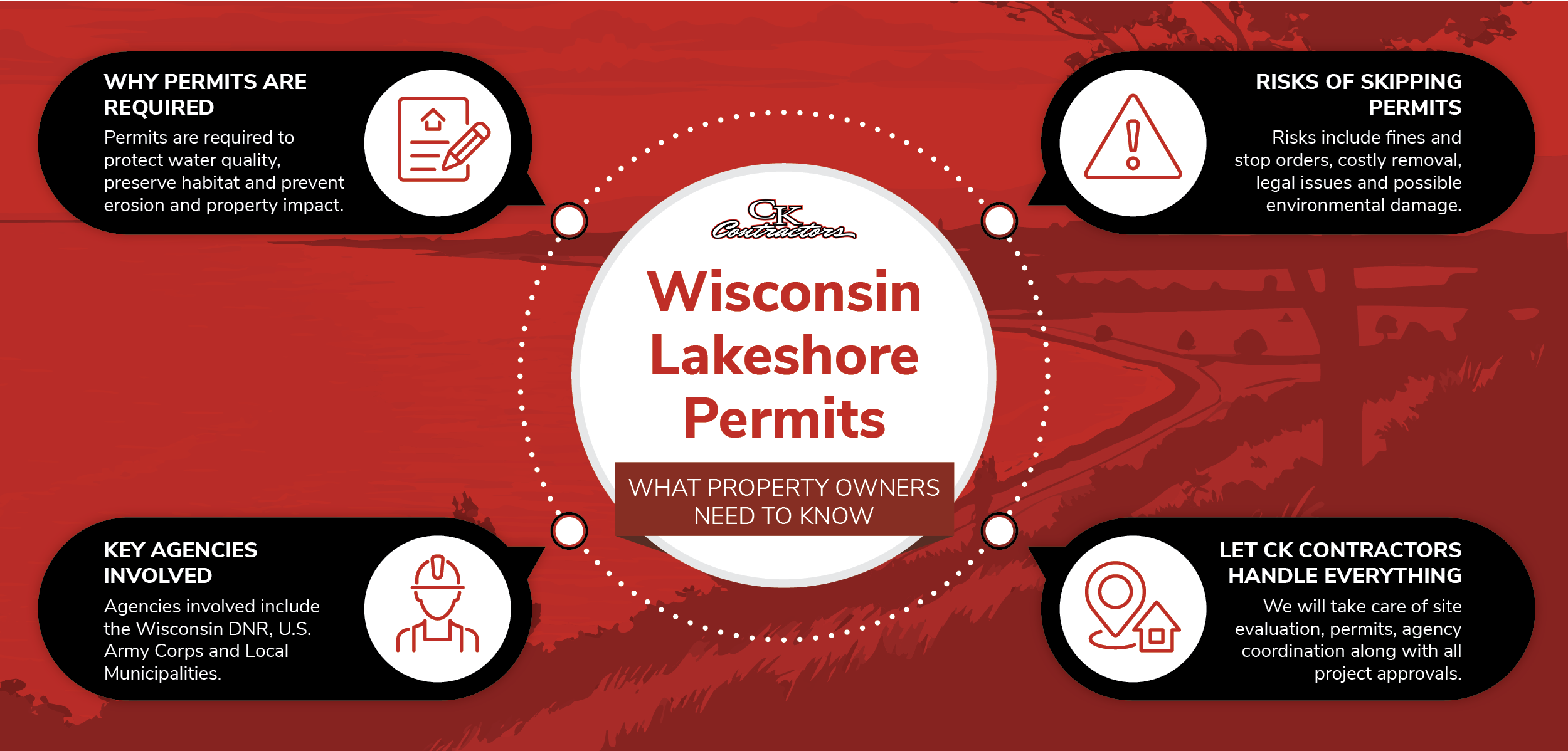
Most Wisconsin lakeshore restoration projects involve at least one, and sometimes all three, of the following regulatory bodies. Understanding who does what helps clarify why the process takes the time it does.
| Agency | Role | Typically Triggered By |
|---|---|---|
| Wisconsin DNR | Primary state permit authority for shoreline work | Grading, riprap, and work within the shoreline setback zone |
| U.S. Army Corps of Engineers | Federal oversight for navigable waters | Larger projects or work below the ordinary high water mark |
| Local Municipality / County | Local setback and zoning requirements | Varies by township (always worth checking) |
Wisconsin Department of Natural Resources (DNR)
The DNR is the primary state authority for shoreline restoration work in Wisconsin. Any project involving grading, riprap installation, or work within the shoreline setback zone will typically require a DNR permit under the state’s Waterway and Wetland programs. For most residential lakeshore restoration projects along Lake Michigan, DNR review is the central step in the permitting process.
Standard DNR review for a routine residential project typically takes four to eight weeks. More complex projects, including those with larger scopes, sensitive habitats, or contested applications, can take significantly longer.
U.S. Army Corps of Engineers
The Army Corps of Engineers provides federal oversight for work in or near navigable waters. This review is most commonly triggered by larger-scale projects or work that extends below the ordinary high water mark. In many cases, Army Corps review runs concurrently with DNR review rather than as a separate sequential step, but it can add time and complexity to the process depending on the project.
Local Municipality or County
Beyond state and federal agencies, many Wisconsin counties and townships have their own shoreline setback requirements, local zoning ordinances, and building permit processes. What is permissible in one township may require additional local approval in another. For properties along Lake Michigan in southeastern Wisconsin, it is important to confirm local requirements before finalizing a project plan.
CK Contractors verifies local requirements for every project as part of the permitting process, ensuring no steps are missed before work begins.
What Triggers a Permit: A Practical Reference
Property owners often want to know whether their specific situation requires a permit before committing to a project assessment. The table below provides a general reference, though CK Contractors recommends a professional evaluation before drawing any conclusions on what permits are required for your project.
| Type of Work | Permit Required? |
|---|---|
| Grading or regrading a bank | Yes. A DNR permit is typically required. |
| Installing new riprap or rock revetment | Yes. DNR permit required. |
| Replacing or adding to existing riprap | Depends. Varies by scope and site conditions. |
| Removing debris or sediment near the waterline | Depends. Consult before proceeding. |
| Any work below the ordinary high water mark | Yes. May also trigger Army Corps review. |
| Native vegetation planting above the ordinary high water mark | No. Typically, no permit is required. |
How Long Does the Permitting Process Take?
Permitting timelines are one of the most common and most avoidable reasons lakeshore restoration projects get pushed from spring into summer, or from summer into fall.
For a standard residential lakeshore project in Wisconsin, property owners should expect:
- DNR standard review: 4 to 8 weeks for routine residential projects
- Larger or more complex projects: 8 to 12 weeks or more
- Army Corps coordination: additional time if federal review is required
- Local permits: variable. Some municipalities process quickly; others have longer queues.
Spring is the DNR’s busiest review period. Applications submitted in April are competing with a significant volume of other requests from property owners who also waited until the season began to start planning. Applications submitted in February or March move through a lighter queue and are more likely to be approved and ready when ground conditions allow work to begin.
| Key Takeaway | The permitting process begins before a single shovel enters the ground. Property owners who start planning in late winter give themselves the best possible chance of permitted, scheduled work in spring rather than spending the spring waiting for approvals. |
|---|
What Happens If Shoreline Work Is Done Without a Permit?
It is worth addressing directly: some property owners consider bypassing the permit process, either because the timeline feels too long or because the scope of work seems minor. This is a risk that is rarely worth taking.
Unpermitted shoreline work in Wisconsin can result in:
- Fines issued by the DNR or local municipality
- A required stop-work order halting the project mid-completion
- Mandated removal or reversal of unpermitted work, at the property owner’s expense
- Complications with property sales, title searches, or homeowner’s insurance
- Neighbor disputes or legal exposure if unpermitted work affects adjacent properties
Beyond the regulatory consequences, unpermitted work that is not properly designed can create new problems, including displacing sediment, accelerating erosion on neighboring properties, or failing structurally within a season or two. Doing it right the first time is always less expensive than correcting unpermitted or improperly executed work later.
How CK Contractors Manages the Permitting Process
For most property owners, the permitting process is the part of lakeshore restoration they are least equipped to navigate on their own. Understanding agency jurisdiction, preparing complete and accurate permit applications, and coordinating across multiple reviewing bodies requires experience that comes from doing this work repeatedly, not from reading a state agency website once.
CK Contractors manages the entire permitting process on behalf of the property owner. That includes:
- Initial site assessment to document existing conditions, evaluate erosion, and determine permit requirements
- Preparation and submission of DNR permit applications, including all required documentation and site plans
- Coordination with the Army Corps of Engineers when federal review is required
- Verification of local township and county requirements for every project
- Follow up with reviewing agencies to track application status and respond to any requests for additional information
Property owners who work with CK Contractors do not need to become experts in Wisconsin shoreline regulation. That expertise is already built into the process. The property owner’s role is to describe the problem and the goals, and then CK Contractors handles the rest.
Starting in late winter or early spring gives clients the best opportunity to secure permitted, scheduled restoration work before peak demand arrives. For properties where site conditions allow early access, work can begin as soon as permits are issued. For others, having permits in hand means no delays once conditions are right.
The Bottom Line
Wisconsin shoreline permitting is not something to figure out the week before a contractor is scheduled to arrive. It is a process that takes time, involves multiple agencies, and requires accurate documentation of existing site conditions. Property owners who understand this and plan accordingly are the ones who get their projects completed on schedule.
The single most effective thing a lakeshore property owner can do right now is start the process. A professional site evaluation establishes what permits are needed and how long the process will take. From there, CK Contractors manages everything, so the property owner can focus on what comes next.
| Ready To Get Started? | Contact CK Contractors to schedule a lakeshore site evaluation. CK Contractors will assess the shoreline, determine permit requirements, and manage the process from application through approval, so work begins on schedule, not after a season of waiting. |
|---|